Simplifying the scheduling process for
professionals and their customers
Improving the professional service schedule process with no more papers.
Main objective
To develop a solution to make managing appointments for professional services easier for professionals and their clients. Professionals can see all their appointments, while clients have the freedom to choose available times and schedule services no waiting for provider confirmation.
The target is simplify and speeds up the scheduling process, providing more autonomy and convenience for both.
Research Results
I talked to potential users throughout the project development. There were some questions and guesses about how the current scheduling process worked and what the main problems were.
The scheduling process isn't the same for all interviewees, but we were able to see some patterns among the majority, such as those listed below.
What is the current process for scheduling services?
- Still, paper is used to manage schedules, especially among low-income professionals.
- Professionals use calendar-style agendas to see dates and times.
- They usually use the WhatsApp app to send confirmation requests.
- A message is sent the day before to confirm the appointment.
- Most professionals create their schedules; this task isn't given to the client since they don't have access to the agendas.
What are the main pains?
- Often, customers don't respond to confirmation requests.
- Manual reminder sent for confirmation request.
- Difficulty in viewing customer history.
- A message is sent the day before to confirm the appointment.
- Difficulty in sharing the schedule with team members (in cases of more than 1 employee).
We chose to use a scheduling calendar as the development base because it closely resembles the appointment systems that potential users were already accustomed to using.
I focused on building a product capable of offering ease, speed, and autonomy for professionals, aiming to solve, as much as possible, all the main pains.
Landing Page
As one of the first steps, I built the landing page that we would use to attract our users. I included some visual communication elements (such as illustrations) and copy designed to convey what we wanted to convey: ease, speed, and autonomy in scheduling.
The solution
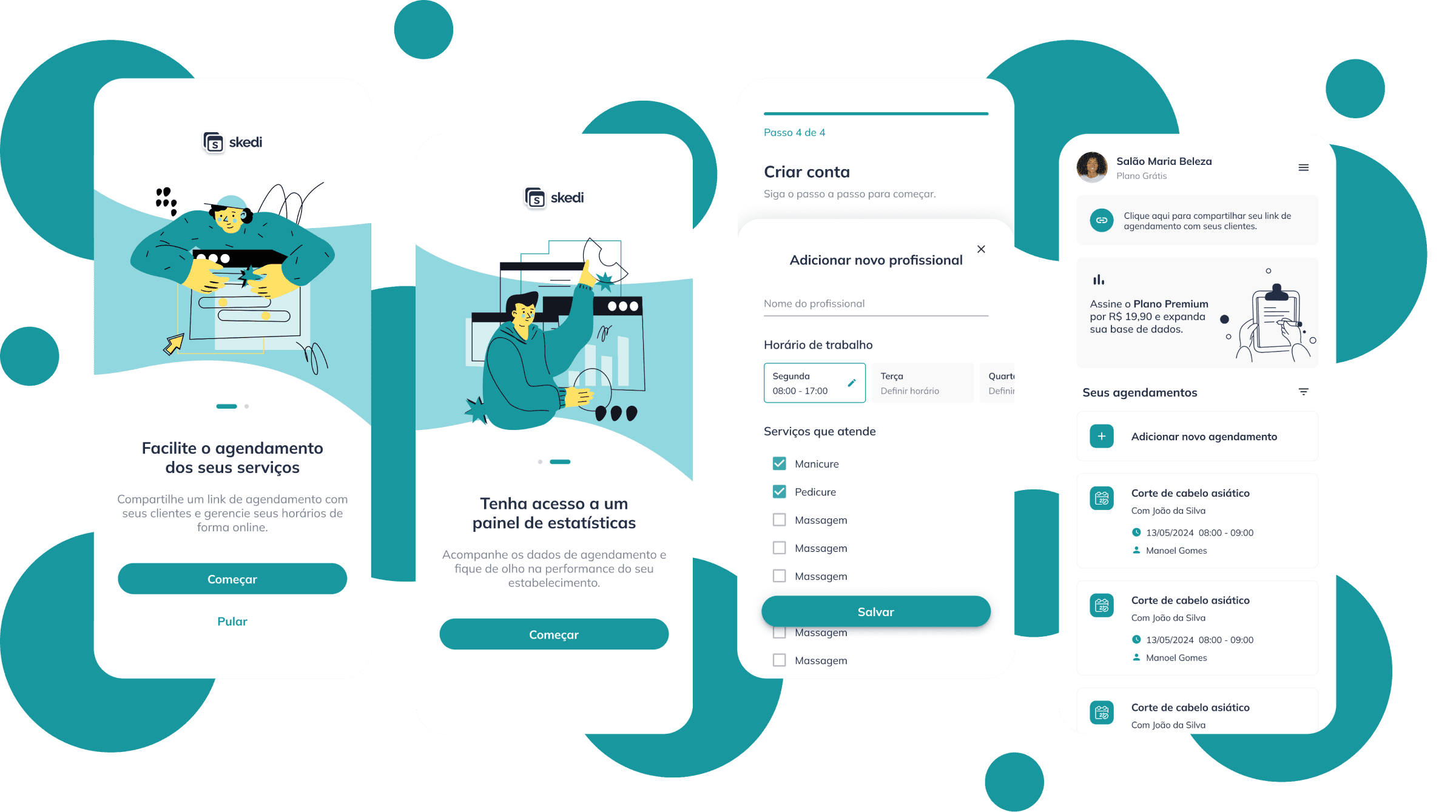
The usability process starts with onboarding, where we request some information about the business and associate it with the user's profile on the platform. This information is also used later to send appointment notifications, providing details about the service to be provided, the name of the responsible professional, the client's name, date, and time.
On the home screen, the logged-in user has access to all the business's appointments. We enable specific viewing with the use of filters, mainly considering businesses with more than one professional (filter by name). It's easy to share the establishment's booking link, giving customers the autonomy to schedule based on availability. The user also has access to their profile on the platform, where they can edit their information at any time.
How did we solve the pains?
- Users can view appointments created by the business and by clients.
- The establishment has access to its own booking link to share and give autonomy to customers.
- Skedi automatically sends push notifications to the client requesting confirmation one day before the scheduled time.
- Users can filter their appointments based on the provider, service, and appointment status (confirmed, completed, or canceled).
Bonus: Dashboard
With a user database in our hands, we hypothesized that offering this data to its owners would be a great value proposition. We created a simple dashboard page with quantitative data about appointments, such as the total number, most scheduled services, most sought-after professionals, and customer recurrence.
With this, we aimed to provide the necessary tools for performance tracking and business analysis. We also sought to encourage a focused look at the data, as we did not measure the intention of using this feature.
Final Note
The product was created with a focus on small businesses that provide services, whether online or not. When developing the MVP, we had two main objectives: to create an easy-to-use solution that would provide a complete and delightful experience for our users. We prioritized essential features and are currently in the testing phase for the release of version 1.0.
@2024 Juliana
Made in figma